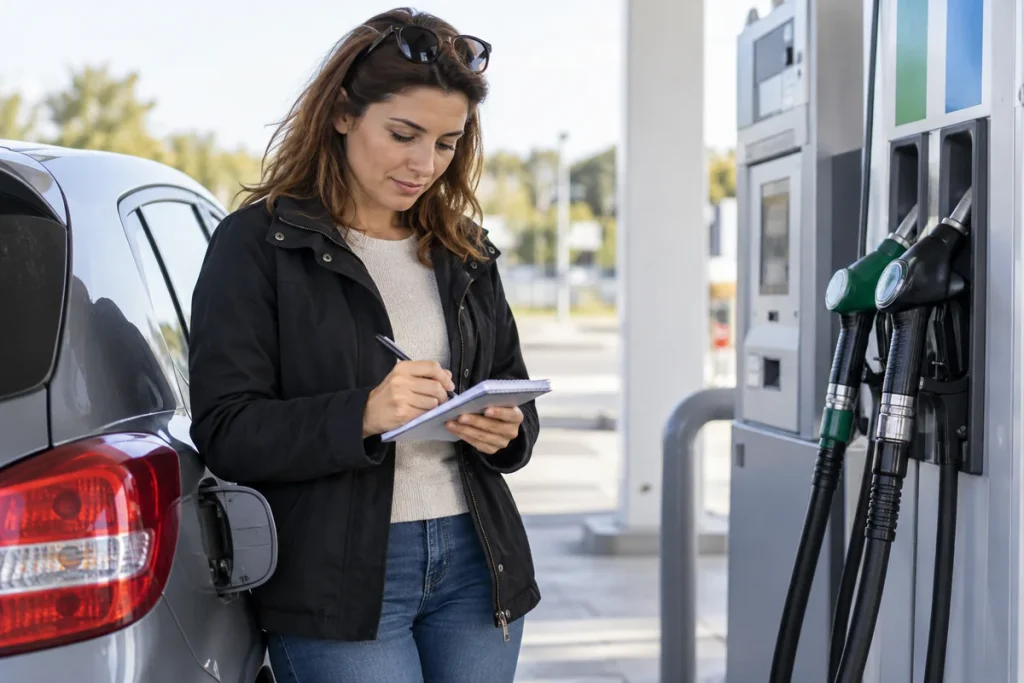
Quick answer: Start with a consistently filled tank and note the odometer. At the next comparable fill-up, record the litres added and distance travelled. In litres per 100 kilometres, the calculation is litres added ÷ kilometres travelled × 100. Repeat the same method over several tanks for a more useful average.
Make the measurement repeatable
Use the pump’s automatic shut-off point as your reference, rather than trying to match the fuel gauge position. Do not keep topping up after the pump stops. Note the starting odometer or reset the trip counter. At the next fill-up, calculate the distance and record the litres shown on the receipt. Where practical, use the same station and pump, a similar filling speed and a comparable fill level. Pump sensitivity, the vehicle’s slope and filling conditions can affect the calculation.
| Record | Example | Note |
|---|---|---|
| Starting odometer | 42,100 km | Record at the first full fill-up |
| Next odometer | 42,550 km | Distance: 450 km |
| Fuel added at the second fill-up | 30 litres | Check the receipt |
| Calculation | 30 ÷ 450 × 100 = 6.7 | About 6.7 L/100 km |
The same example can be expressed as kilometres per litre: 450 ÷ 30 = 15 km/L. These describe the same measurement in different ways. A lower L/100 km figure indicates less fuel used per distance; a higher km/L figure indicates more distance per litre. Always write the unit when comparing records. Do not compare UK mpg directly with US mpg: the gallon sizes differ.
Why one tank is not a definitive result
Short city journeys, cold weather, hills, traffic, air conditioning, load, tyre condition and driving style can change consumption. The pump may also stop at a slightly different point each time. The US Environmental Protection Agency’s personal tracking method compares the initial and following fill-ups, stresses consistent filling and suggests averaging two or three tanks for a better estimate. This is a personal record method, rather than an official consumption rating, warranty value or fault diagnosis.
Keep a simple record of the date, odometer, litres added, the balance of city and longer-distance driving, and unusual conditions. If one tank produces a high figure, compare the longer-term trend, maintenance history and road conditions before assuming a component has failed. Show persistent or sudden changes to a qualified workshop.
Use the trip-cost calculator to estimate a journey in kilometres or miles. For your maintenance documents, see the service-visit checklist.
Source: US EPA — Transportation, air pollution and climate change: frequently asked questions. The original miles/gallons tracking method is expressed here in litres and kilometres.
Original source review: 1 November 2026. English edition: 3 November 2026.
Keep your maintenance notes in My Garage. For a general question, ask the community, or explore the guide collection.