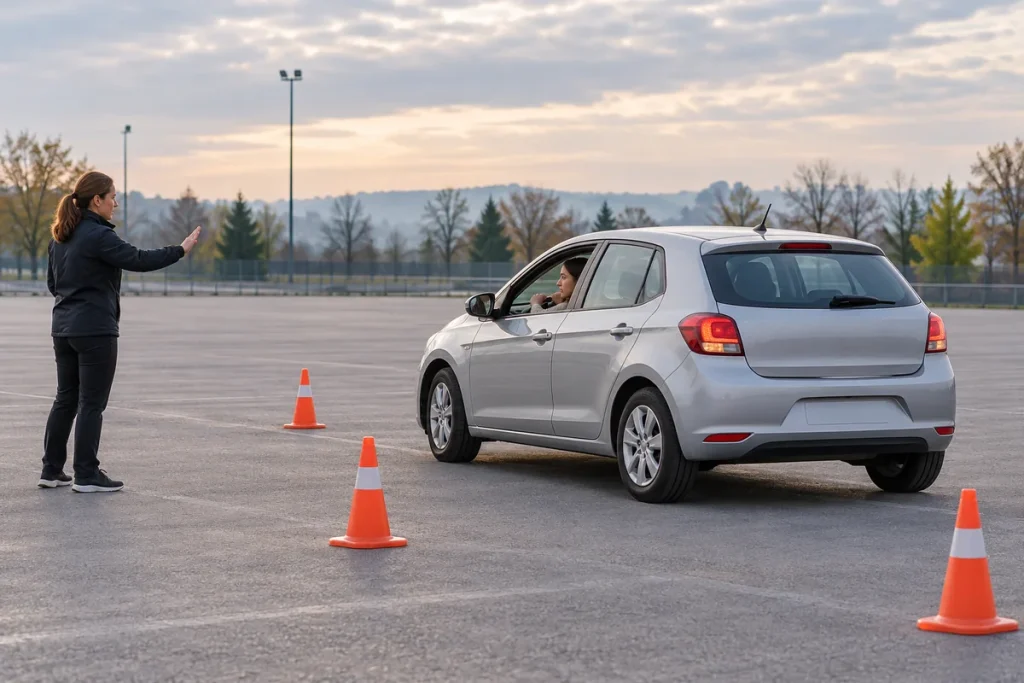
Quick answer: Plan short, focused parking sessions in a permitted area separated from traffic and pedestrians, with an instructor or appropriately qualified supervisor. Begin with vehicle control and observation before narrower spaces. Stop if the area or control of the vehicle becomes uncertain.
Parking is several skills
Fitting inside lines is only part of parking. Surrounding observation, low-speed control, interpreting mirror information and stopping to reposition also matter. NHTSA’s driver-education documents illustrate progressive training in controlled areas. They do not establish local licensing or supervision rules.
Confirm permission to use the area and the learner’s legal documentation and supervision conditions. Identify pedestrians, moving vehicles, poles, kerbs, uneven surfaces and obscured areas. End the session if conditions become unsuitable.
Set one goal
Prepare the seat, mirrors, belt and controls while stationary. Choose one skill: approaching markings, observing while reversing or assessing visibility when leaving. Mirrors do not show every surrounding area.
Stage one is familiarisation with dimensions, controls, views and an instructor-chosen starting point. Progress when you and the instructor agree that calm stopping and starting are controlled.
Stage two uses wide, empty spaces, with observation and the option to stop and reposition. Stage three considers different or narrower spaces only when the instructor judges observation and control consistently suitable.
These stages are discussion aids, not official test standards or guarantees. NHTSA treats different parking entries and exits as distinct learning objectives; you need not practise every type at once.
Check each repetition
Have you checked people and moving traffic? Is speed appropriate to the instruction and ability to stop? Do you understand observation beyond mirrors? Can you stop to reassess position? Are you requesting feedback rather than forcing an error?
Afterwards, note what was practised and the next question. A sample note might identify difficulty judging one side and ask which additional surrounding check to use. It is a note template, not a claimed success story.
Pause if visibility closes, the area becomes busy, supervision is concerned or the manoeuvre feels rushed. Cameras and sensors remain supporting systems with model-specific limits.
Sources
Original Turkish guide source review: 29 October 2026. English edition: 4 November 2026. Follow the current rules where you drive and the instructions for your exact vehicle and equipment.