Quick answer: Screenwash and engine coolant serve different systems and are not substitutes. Identify neither reservoir nor product by colour alone. Use the exact model’s engine-bay diagram, reservoir name and cap symbol together; obtain help before filling if unsure.
Different liquids, different systems
Screenwash serves windscreen and rear-window washers and, depending on equipment, other washers. Engine coolant serves the relevant cooling circuit. The word antifreeze can occur in different product descriptions without making those products interchangeable.
Ford specifically warns against putting coolant into the washer reservoir because spraying it on the glass can impair visibility. Read the product’s full intended use rather than deciding from one word on the label.
Three checks for identifying a reservoir
Open the engine-bay diagram for the correct model year and engine. Match the named component and location to the vehicle. Verify the cap symbol and the corresponding fluid/filling instructions rather than relying on cap colour.
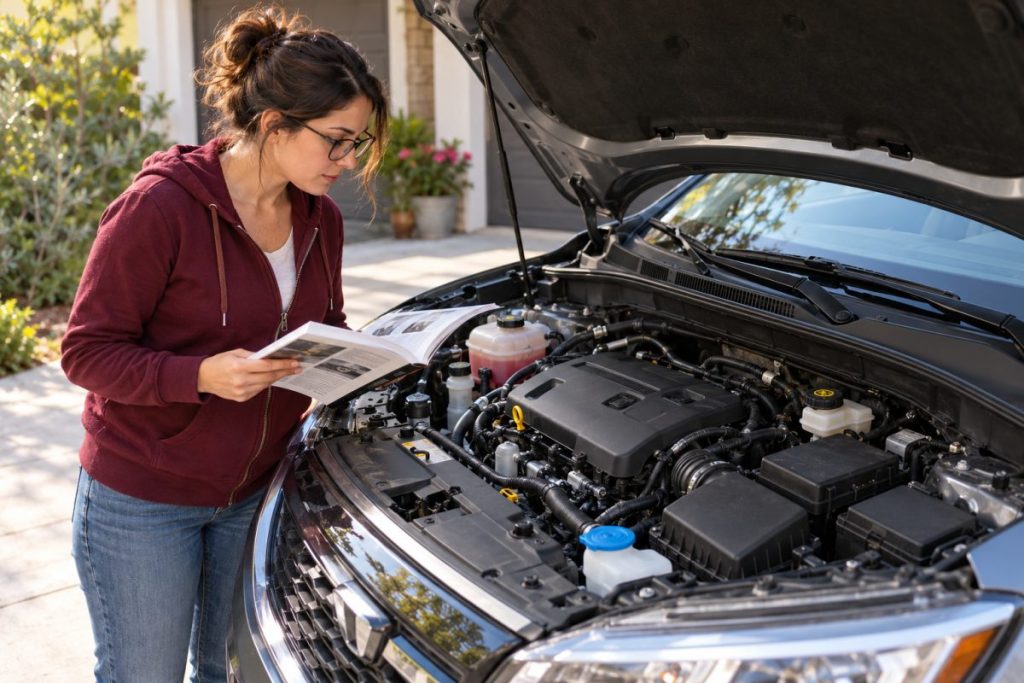
Layouts may differ between engines of the same model. Do not treat one online photograph as a universal map. If a cap has been replaced, a marking is missing or the location cannot safely be accessed, ask a specialist. The article’s cover image is not a technical diagram for your car.
Colour does not establish product identity
Shell explains that coolant colour alone does not establish technical properties or suitability. For screenwash too, check the full application and instructions. Similar-looking bottles do not belong in the same reservoir simply because their colours match.
A winter screenwash and engine coolant may have similar shades. Ask which system each is for first. Keep original labels and packaging; do not transfer automotive liquids into unlabelled drink bottles.
If you suspect an incorrect fill
Stop filling and do not assume topping up with the correct liquid resolves the issue. Seek manufacturer or qualified workshop advice before starting the vehicle or testing the washer system. Do not attempt draining, hose removal or chemical correction yourself.
Explain the exact product, approximate quantity, suspected reservoir and whether the vehicle was operated afterwards. Clearly identify anything uncertain. Different liquids and systems do not share one universal correction.
Do not identify a hot system by opening it
Ford’s cooling-system instructions warn of burns from a hot cap. Learn safe checking conditions from your own handbook rather than assuming one waiting period is sufficient for every model.
Sources
Original Turkish guide source review: 29 October 2026. English edition: 4 November 2026. Follow your exact vehicle and equipment instructions.